
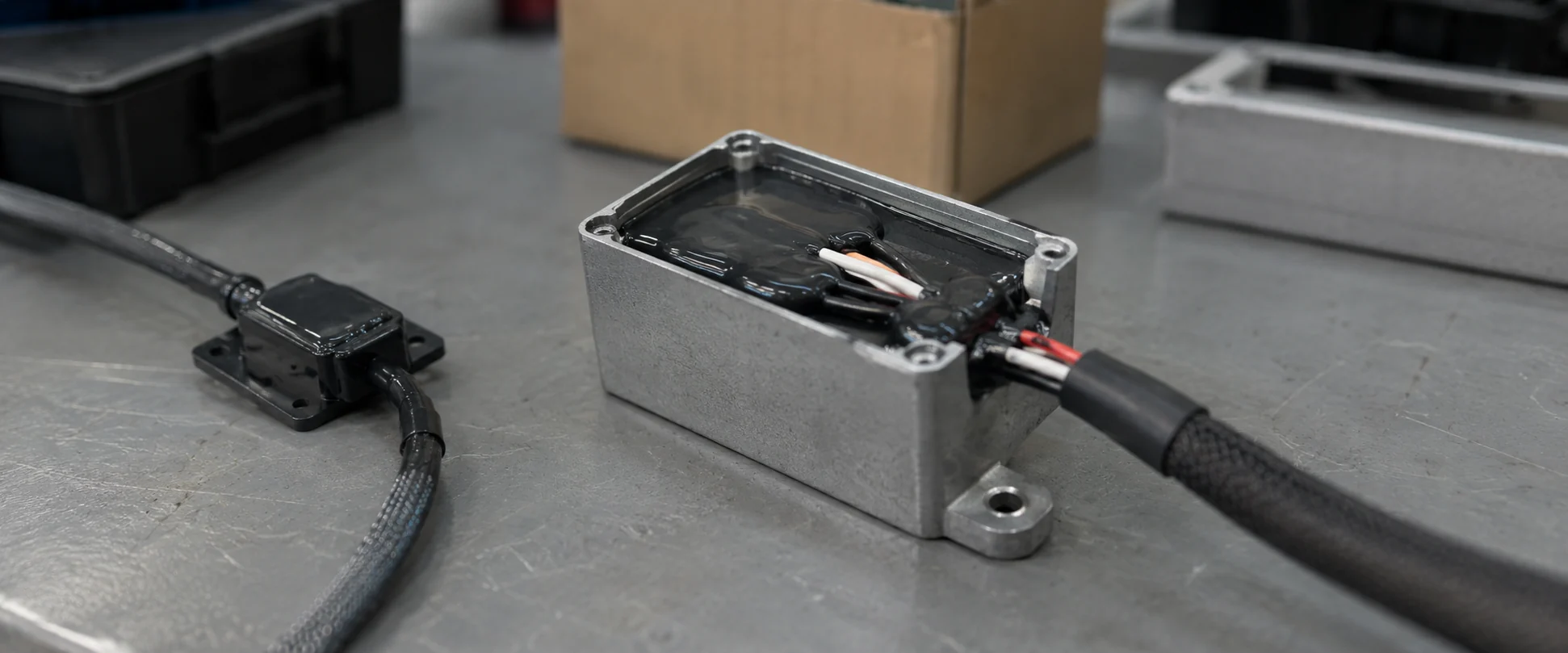
Cable potting and encapsulation for custom assemblies
Justicia Marin is a B2B supplier of cable potting and encapsulation of cabling and connections, for manufacturers and integrators. We start from your drawing, sample or specification: you define which area must be protected and which must remain accessible, and we coordinate the supply with specialised manufacturers.
What it is and what it protects
Cable potting and encapsulation: what it is and what it is used for
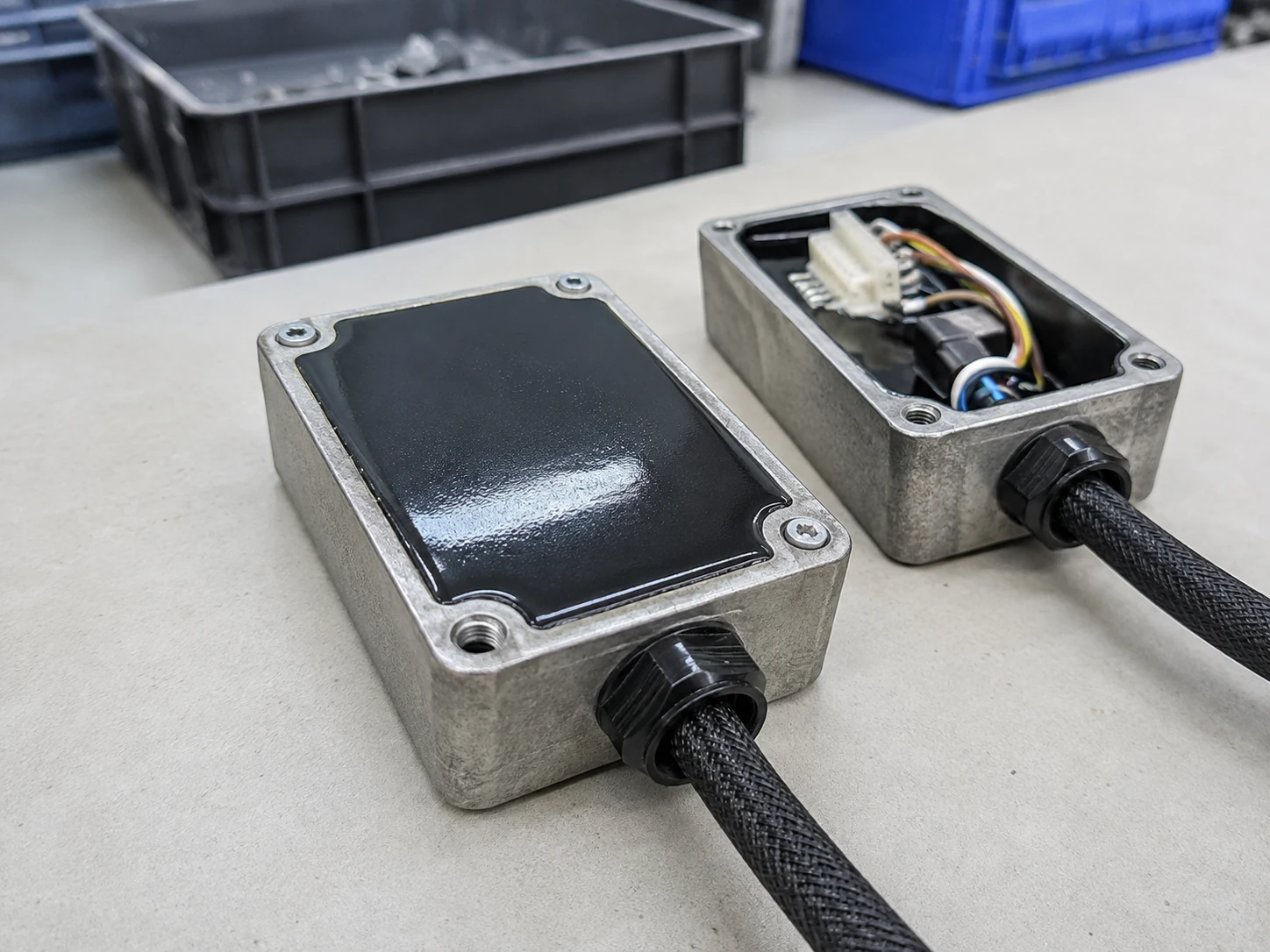
Resin encapsulation consists of filling a defined area of an electrical assembly with a material that cures around the connections or components to be protected: a joint, a termination, the cable entry or the inside of a box. On this page we use potting to refer to that same resin encapsulation; the specific scope depends on the material, the geometry and the process specified. The protection achieved is not a fixed property: it depends on the material defined, the configuration of the area and the expected environment.
Decision criteria
What the right process depends on
There is no universal encapsulation. The material and the scope come from the working environment, the materials involved and how the part must be assembled afterwards. Overmoulded cable assemblies (overmolded, in US spelling) — with a moulded strain relief or boot instead of a filled cavity — are a related but different process: if your drawing calls for one, tell us and we will ask the manufacturers in the network whether they can quote it.
Working environment
Humidity, salinity, dust, chemicals or outdoor exposure determine both the material and the scope of the area to protect. The requirement is best described before choosing the process, not after.
Mechanical stress
Continuous vibration, pull on the cable or repeated flexing may require mechanical reinforcement at the exit area, in addition to sealing. These are different requirements and are not always solved with the same material.
Material compatibility
The potting material must coexist with the cable insulation, the connector and the housing. Compatibility is checked on the specific configuration of the project, not in the abstract.
Assembly and free areas
The final geometry must allow the later assembly. It is worth defining from the start which interfaces and elements must remain accessible, because potting can limit rework, disassembly or replacement later on.
Starting data and criteria
What to define before requesting cable potting and encapsulation
The quote is prepared on the information available and sets out in writing the scope the selected manufacturer can take on.
Decision points
Documentation, sample and continuity before the supply is repeated
These three milestones turn an initial need into a configuration that can be ordered again without reinterpretation.
You describe the environment
What the assembly will be exposed to, for how long and with what mechanical or sealing requirement.
Protected sample
You validate the finish, the geometry and the fit on your equipment on a sample before the process is applied to a series.
Series with fixed criterion
The approved configuration is documented so that later deliveries keep the same finish.
How we coordinate the supply
How we manage cable potting and encapsulation
We start from your real application requirement, not from a closed catalogue of finishes.
Starting documentation
Drawing, sample or photograph of the assembly, together with the area to be protected and the environment it will be exposed to.
Process proposal
We consult the manufacturers in the network on which process and material fit that configuration, and what implications they have for the later assembly.
Sample and approval
When the project requires it a sample is prepared. You check the finish, the geometry and the fit on your equipment before committing to a quantity.
Recurring supply
The approved configuration is documented so that later deliveries keep the same scope and the same criterion.
Coordinated manufacturing
Cable potting and encapsulation with specialised manufacturers
The right manufacturer depends on the area to be protected, the geometry of the cavity, the material or requirement defined, the interfaces that must stay free, the quantity and the agreed checks. We select and coordinate the one that fits that combination.
Do you need a supplier for cable potting and encapsulation?
What shapes cable potting and encapsulation
From approved sample to recurring supply
Does your assembly work in a demanding environment?
Tell us what it is exposed to.
With the working environment, the materials involved and a photo of the assembly we can propose a protection process and its cost.
What you can send us
Tell us what you need to buy
We reply within 1 working day.