
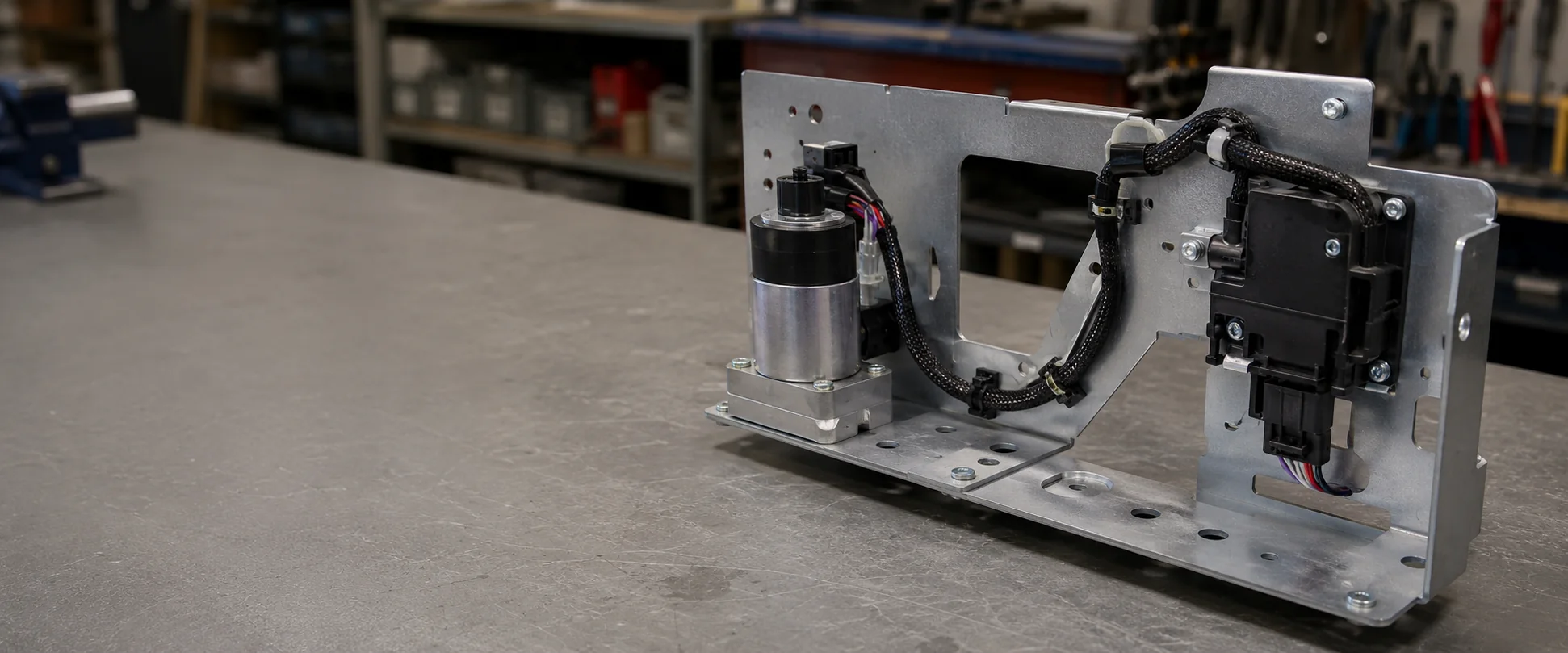
Electrical sub-assemblies built to drawing and bill of materials
The assembly of electrical sub-assemblies consists of placing on a single support the components and cabling that until now reached you loose, and leaving them positioned, fixed and connected according to your documentation. The same operation is often requested as electrical sub-assembly or electromechanical assembly, depending on which components go into the part number. The input is a drawing and a bill of materials. The output is an assembled sub-assembly, not a finished machine: your machine or final product remain yours. And the hard part is not assembling, it is agreeing where our scope ends and your process begins.
What it involves
What goes into electrical sub-assemblies and what does not
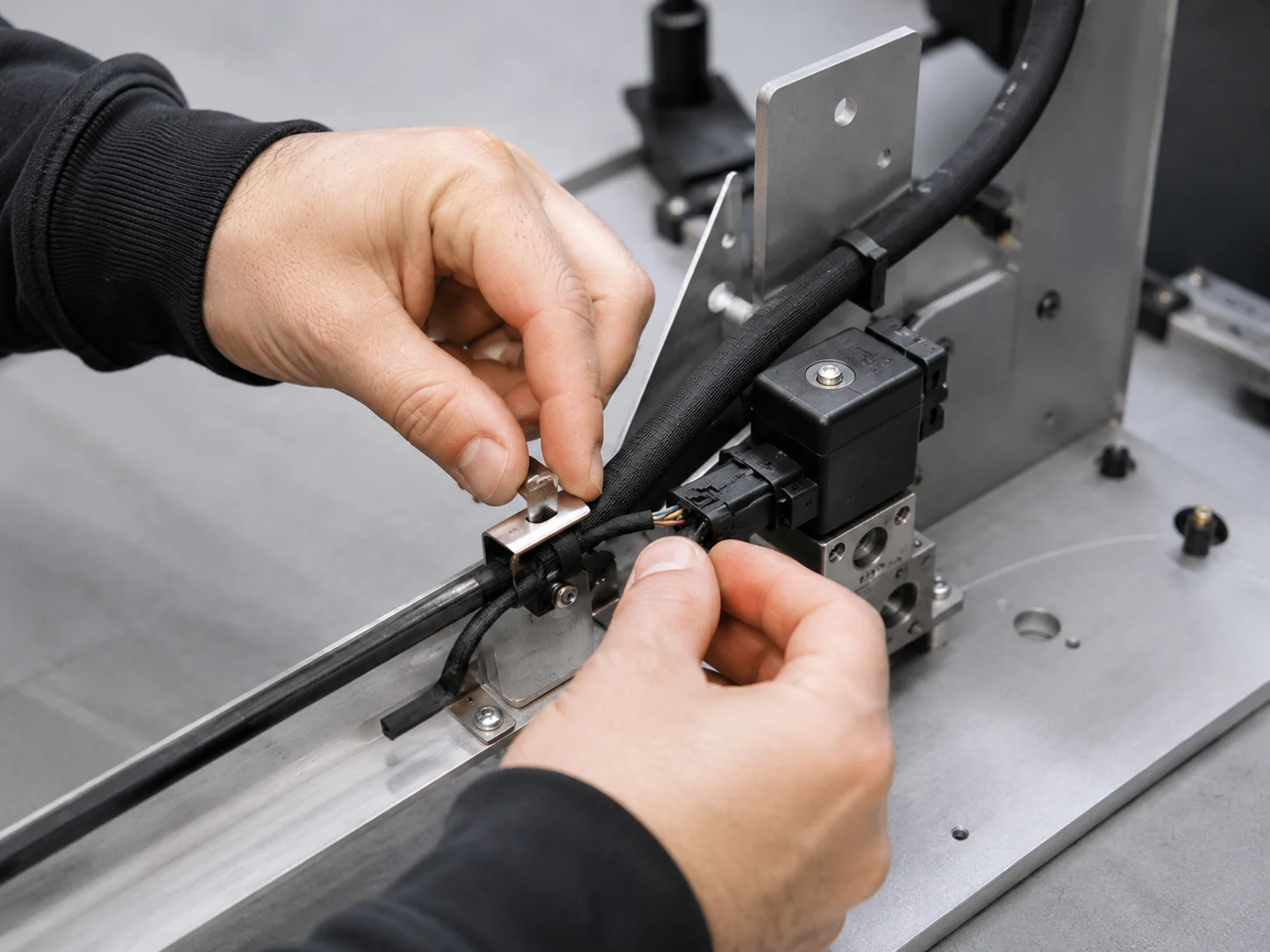
Assembly starts when the cabling is already finished. A custom-made harness is an item in itself; here that harness is positioned on the structure, routed where the drawing indicates, held at the planned points and connected to the elements already mounted. Alongside it go brackets, fasteners, actuators or modules, according to the bill of materials. When the part number is almost all cabling and connections we usually speak of electrical sub-assemblies, and when it incorporates support, fixing or moving elements, of electromechanical ones: the assembly work and the way of defining it are the same. What comes out is a sub-assembly assembled according to the agreed definition, with the scope closed in writing.
Process control
Verifiable criteria of electrical sub-assembly assembly
The acceptance criterion for the assembly of electrical sub-assemblies is agreed in writing before the order and depends on the part number and the assigned manufacturer. On receipt the assembly is checked against your documentation; the electrical and functional verification of the assembly is defined separately and is not taken as included.
How this process is coordinated
How the assembly of electrical sub-assemblies is defined
Subcontracting the assembly of a sub-assembly is viable as soon as the operation is defined, and the physical assembly is carried out by the assigned manufacturer: Justicia Marin does not do it. The critical point is to agree where our scope ends and your process begins. Everything else follows from there.
We analyse the current assembly
We review what you assemble today piece by piece on your line and with what documentation you do it.
We fix the scope
We define in writing what the sub-assembly includes, which operations stay outside and in what state it is delivered.
Assembled sample
You receive the assembled sub-assembly to validate it on your real product before committing to a quantity.
Stable part number
The approved configuration is documented and repeated identically in later deliveries.
What has to be decided
What decides the scope of electrical sub-assemblies
Four decisions to close before assembling, both for an OEM that outsources an operation of its line and for an equipment manufacturer that wants to receive the assembly already integrated. None of them is about purchasing: all are about definition.
Which components go into the part number
A closed list, with the equivalents you accept in writing. What is not on the list does not go into the sub-assembly.
Where our scope ends
Which operations are done before reaching your line and which remain yours. It is the decision that is hardest to change afterwards.
How it is positioned, fixed and connected
Position on the support, cable route, fixing points and orientation of each connector, according to the drawing.
How the assembled sub-assembly is accepted
What is checked on receipt against your documentation. Electrical and functional verification is agreed separately.
Do you assemble piece by piece today?
Tell us which operations your line carries out.
With the list of components, the drawing and a photo of the assembly we define the scope of the sub-assembly and its cost.
What you can send us
Tell us what you need to buy
We reply within 1 working day.