
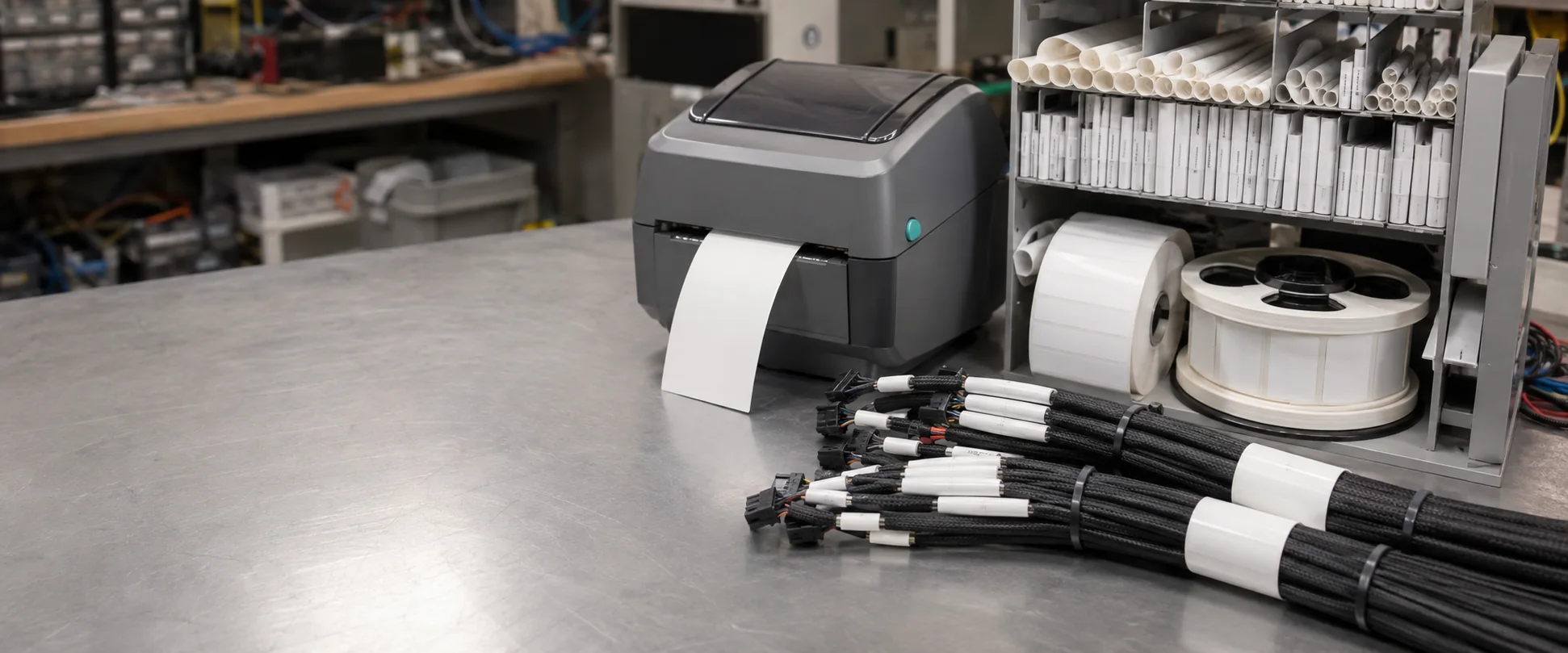
Wire and cable marking, labelling and grouping to specification
Wire and cable marking is the physical process that carries onto the material the coding that already exists in your documentation. The result is identification: anyone can tell, without interpreting, what each end is and where it goes. Grouping is the second branch of the same job: fixing the layout of the assembly so that it reaches the line with the agreed configuration. An assembly without identification forces people to interpret, and whoever interprets sometimes gets it wrong: at assembly, and above all in maintenance, months later with the equipment already installed.
What it involves
What wire and cable marking solves
Marking and labelling are not the same. Marking goes on the cable or conductor itself — a sleeve, a ring, direct printing — and travels with it. Labelling adds an adhered or wrap-around carrier that allows longer texts, codes and full nomenclatures. Both coexist in the same assembly, and which one is used at each point is decided by the project documentation. From there comes identification: each conductor, each branch or the complete assembly associated with its function or its destination. Grouping then orders the assembly physically, so that it arrives with the shape it will have once installed and not as a bundle to be untangled.
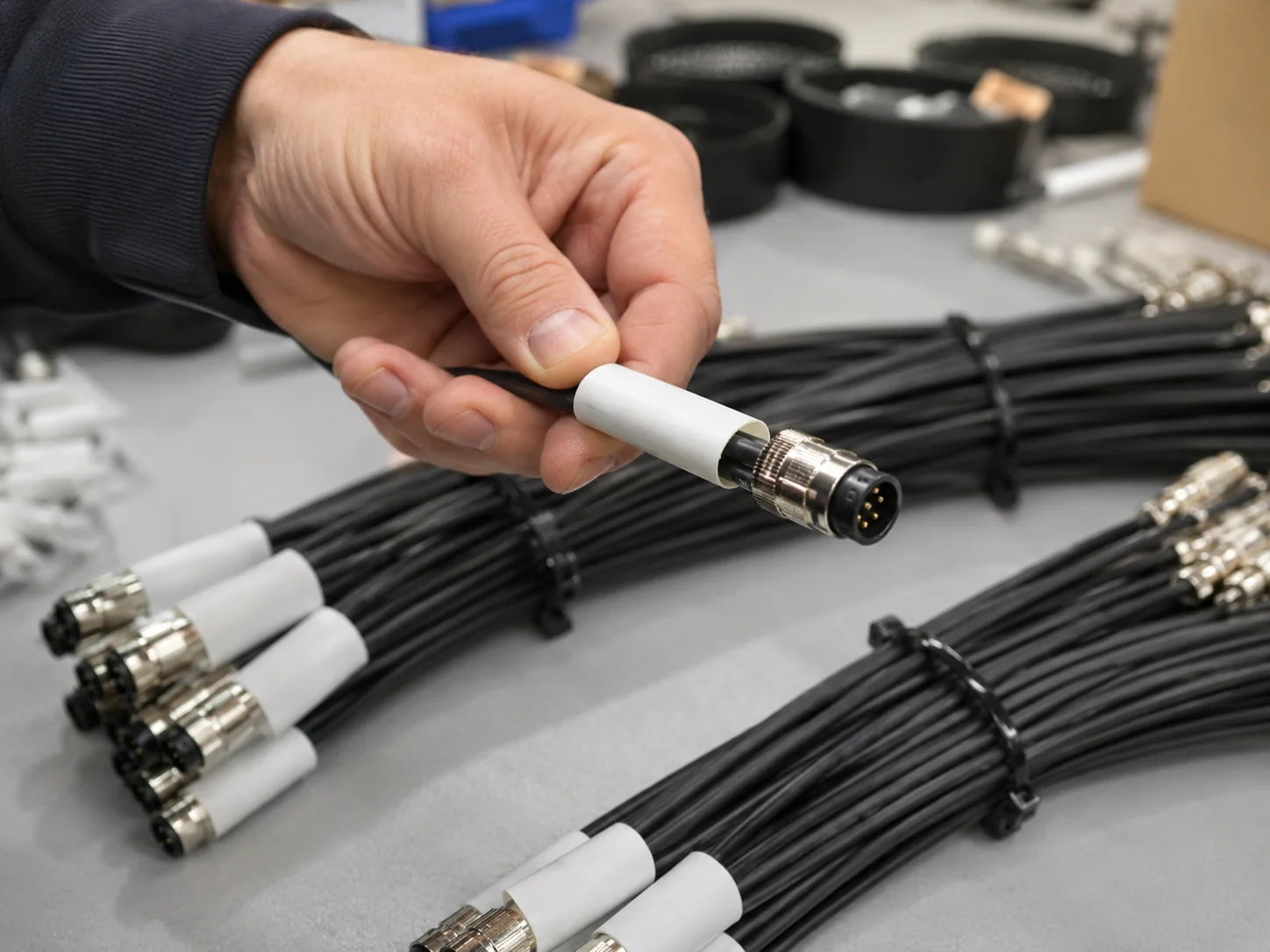
Process control
Verifiable criteria of marking and labelling
The acceptance criterion is agreed in writing before the order and depends on the part number and the assigned manufacturer. On receipt only what was specified can be checked: what is not written cannot be verified. That is why this list does not describe what we offer, but what has to be settled with you before the batch is launched.
How this process is coordinated
How the wire and cable marking of your assemblies is defined
The nomenclature is set by your documentation: we reproduce it, we do not invent it. These four steps are what prevent a criterion being lost between the order and the assembly line.
You give us the nomenclature
The identification criterion of your schematic, your maintenance system or your internal standard, exactly as already written.
We agree the method
We review the requirement and coordinate with the manufacturer which type of marking or labelling fits the expected environment and the length of the text.
You validate a sample
You check legibility and appearance on a real sample before it is applied to the complete batch.
It is applied to the batch
The identification stays identical in later orders, so as not to break your documentation or your history.
Common methods
Methods of wire and cable marking and labelling
The choice depends on the expected environment, the length of the text and who is going to read the mark: an operator on the line or a technician in the field two years later.
Ring or heat-shrink sleeve
Marking on the conductor itself: the sleeve stays integral with the cable and does not depend on an adhesive. It is the usual option when an adhered label is not accepted.
Printed labelling on the cables
Adhered or wrap-around carrier with printed text or code. It allows long nomenclatures that do not fit on a sleeve.
Grouping of the harness
Cable ties, spiral wrap, braid or sleeve that fix the layout of the assembly according to the agreed configuration. Mechanical or environmental protection is a different capability.
Colour coding
The colour of the conductor or of the identifier as a quick visual aid in assembly, always subordinate to the written code.
Does your assembly arrive without identification?
Pass us your nomenclature criterion.
With your schematic and your identification criterion we coordinate the supply of marked, labelled and grouped assemblies, ready to fit.
What you can send us
Tell us what you need to buy
We reply within 1 working day.