
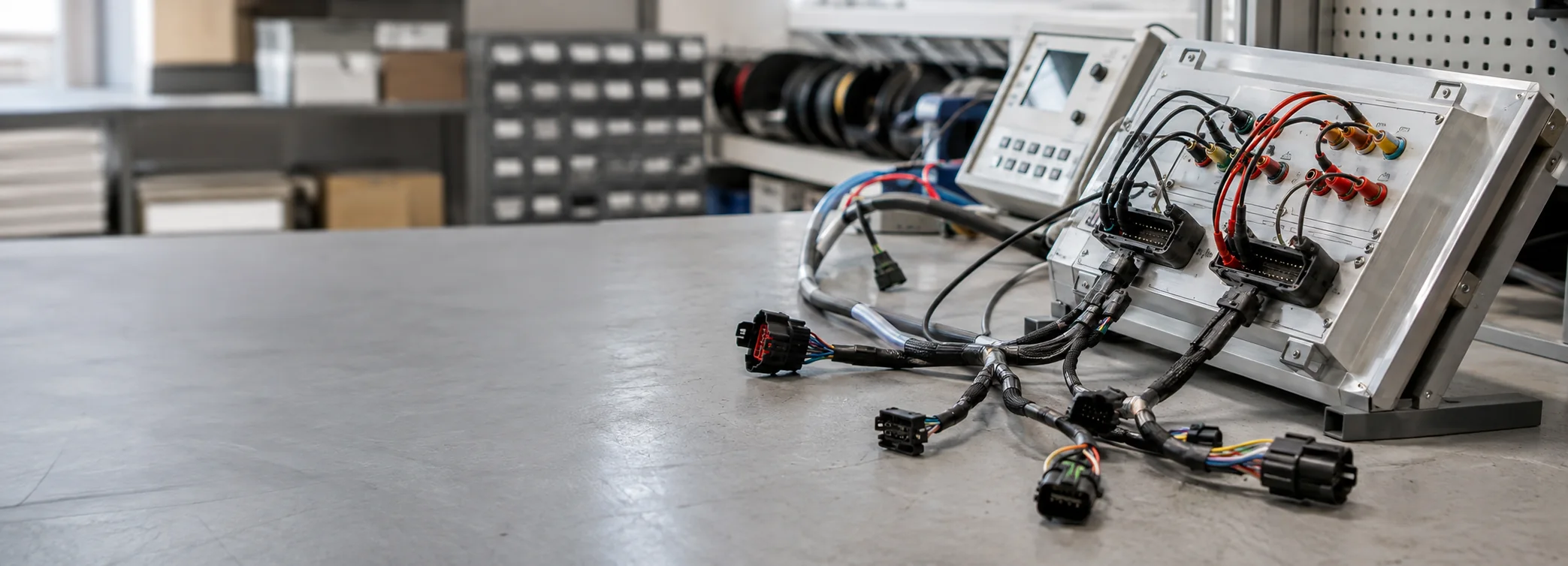
Electrical testing of cable assemblies to schematic and acceptance criteria
An assembly can be perfectly manufactured and still have a crossed point. Electrical testing of cable assemblies exists so that this error appears before the assembly leaves for the customer, not when it is already mounted inside a closed piece of equipment. We are talking about assemblies and harnesses made to documentation: not the electrical installations of a building or network cabling certification.
What it involves
What electrical testing of cable assemblies checks
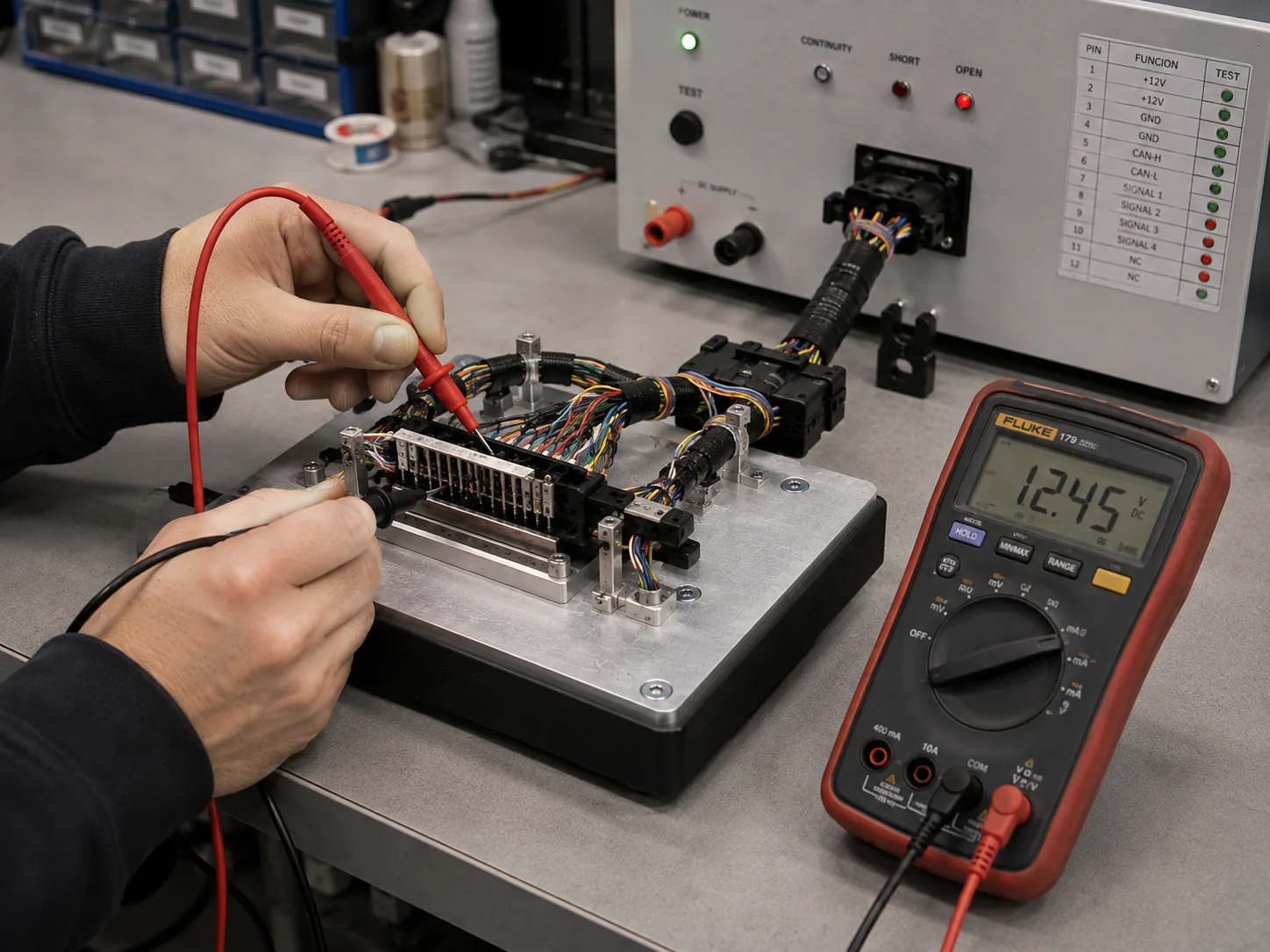
The basic check confirms continuity — that each conductor conducts — and configuration — that it goes from the right point to the right point. That second check is the one that detects crossings, which are the most expensive failure to find once the equipment is assembled. Everything is compared against a reference: the wiring diagram, the contact table or the approved sample. Without that reference there is no result to judge.
Process control
Verifiable criteria of electrical testing
The acceptance criterion for electrical testing of cable assemblies is agreed in writing before the order and depends on the part number and the assigned manufacturer. What is not defined beforehand cannot be judged afterwards: this list does not describe what we offer, but what has to be settled with you.
How this process is coordinated
How the scope of electrical testing is agreed
The essential thing is to fix it before the order, not negotiate it after an incident.
You tell us the criticality
What consequence a failure has in that assembly and what level of checking you need per batch.
We check feasibility
We consult with the manufacturer what check it can really carry out on that type of assembly.
It is reflected in the quote
The scope of the check and its record are detailed in writing as part of the conditions.
It is applied on every delivery
The agreed criterion is kept in later orders, not only in the first.
What has to be decided
What level of electrical testing each assembly needs
These four axes define the scope of electrical testing of cable assemblies and are made specific in writing before each order.
Which connections must exist
The circuits that the schematic declares mandatory and that must show continuity from one end to the other.
Which connections must not exist
Crossings between circuits and contacts that should have no relation to each other. It is the most expensive failure to find late.
Which reference defines the result
Schematic, connection table or approved sample, with its revision. Without a reference there is no criterion to apply.
How it is accepted and recorded
Whether the check is per unit or by sampling, and whether the result must be documented. It is agreed in the quote.
What level of verification do you need?
Tell us how critical the assembly is.
With the criticality of the assembly and your control requirement we define the scope of the verification and reflect it in the quote.
What you can send us
Tell us what you need to buy
We reply within 1 working day.